Wednesday, April 8, 2015

Dnyaneshwari, 1990 - Stamp, First Day Cover


ज्ञानेश्वरी (Jnāneśvarī) is a commentary on the Sanskrit Śrīmad-Bhagavad-Gītā in Marathi language written by Sant Jnāneśvar. It is also known as Bhāvārthdīpikā. Sant Dnyaneshwar* elaborated Śrīmad-Bhagavad-Gītā, which consisted of 700 Sanskrit verses, into around 9999 Marathi verses (ovīs). Thus it became handy and accessible to the Marathi speaking common man.


India Post issued a special stamp in the denomination of 200P on 31.12.1990 to commemorate the 700th Anniversary of Jnāneśvarī. Though the book is purely in Marathi language, the author was an erudite Sanskrit scholar and commentator - a Bhāṣyakāra. He is also attributed to have written commentaries on the Yoga-vāsiṣṭha and Pañcīkaraṇa in Marathi; the language of the masses.

In the year 1997 a commemorative stamp of 500P denomination on Sant Jnāneśvar was also released which also finds a place here.


*I am yet to understand how Jnāneśvar is written on the stamp as Dnyaneshwar. In the northern parts of India it is generally scribed like this. The letter "ज्ञ" is a combination of जकार - jakāra and ञकार - ñakāra. So how come this Dakāra, etc.......enter?

Sir William Jones, 1997 - Stamp and First Day Cover


The Sanscrit language, whatever be its antiquity, is of a wonderful structure; more perfect than the Greek, more copious than the Latin, and more exquisitely refined than either, yet bearing to both of them a stronger affinity, both in the roots of verbs and the forms of grammar, than could possibly have been produced by accident; so strong indeed, that no philologer could examine them all three, without believing them to have sprung from some common source, which, perhaps, no longer exists; there is a similar reason, though not quite so forcible, for supposing that both the Gothic and the Celtic, though blended with a very different idiom, had the same origin with the Sanscrit; and the old Persian might be added to the same family.
-- William Jones on Sanskrit Language


Sir William Jones (1746-1794) is often credited with establishing the Indo-European family of languages and founding comparative linguistics. 

The Asiatic Society was founded by Jones on 15.01.1784.

Sacontala or the Fatal Ring: an Indian Drama (1789) is a translation of Sākuntala of Kālidāsa by William Jones.

President's Review of the Fleet, 1984 - First Day Cover


On the occasion of the impressive ceremony of the President reviewing the Fleet of Indian Navy, a special se-tenant block of 4 stamps were brought out on 12.02.1984. The FDC displayed the Naval insignia with the motto in Sanskrit. Please see other postings on the subject for explanation using the SEARCH option.


शं नो वरुणः
śaṁ no varuṇaḥ

Hanuman Prasad Poddar, 1992 - Stamp First Day Cover and Brochure


Sri Hanuman Prasad Poddar (1892–1971), the multi-faceted personality was a freedom-fighter, author, editor, orator, poet, linguist, and a publisher. He achieved excellency in all these field of activities even though he had very little formal schooling. He edited and published the spiritual monthly journals "Kalyāṇ" in Hindi (1927) and "Kalyāṇ Kalpataru" in English (1934) and these magazines still continue to be in circulation with more than 250,000 membership!!! He set up the Gita Press at Gorakhpur (UP) to publish books on Hinduism and Indian tradition. He spread the knowledge contained in the Upaniṣads, Bhagavad Gītā, Rāmāyaṇa (both Vālmikī and Tulsīdās)  the Mahābhārata and abridged versions of the Purāṇas, etc. by translating the texts into Hindi/English and bringing out low cost editions to be within the reach of everyone. He will not tolerate even a single spelling mistake if found out after the print and will see that it is corrected with pen in all those millions of copies!!! All the bound volumes are still clothed in khādi. 
Personally I too am one who has derived immense benefit through these Gita Press low cost but high standard editions. I still preserve all those volumes which I read, learned and studied, in my personal grantha-kośa (library).

My Śraddhāñjali unto you
Sri Poddarji 
for whatever great
that I have acquired through your authentic editions.

प्रणमामि
The FDC


Tuesday, April 7, 2015

Acharya Tulsi, 1998 - Stamp, First Day Cover and Brochure


Besides being a profound scholar in Rajasthani and Hindi languages and Jaina Agamas in particular, Acharya Tulsi has authored a few Sanskrit books too on Jainism. These include:
जैन-सिद्धान्त-दीपिका - Jaina-Siddhānta-Dīpikā
श्री-भिक्षु-न्याय-कर्णिका - Śrī-Bhikṣu-nyāya-karṇikā
मनोनुशसनम् - Mano'nuśāsanaṃ
पञ्च-सूत्रम् - Pañcasūtraṃ


The India Post honoured the great ascetic Shri Acharya Tulsi by issuing a commemorative stamp. A First Day Cover along with a brochure too were released on 20.10.1998. The stamp and the postmark are inscribed with a symbol that has the Sanskrit phrase:

संयमः खलु जीवनम्
saṁyamaḥ khalu jīvanam
"Self-control indeed is Life"
The Postmark

The FDC


The Brochure 2 & 1

BIPEX-86, Meghdoot, 1986 - Special Cover


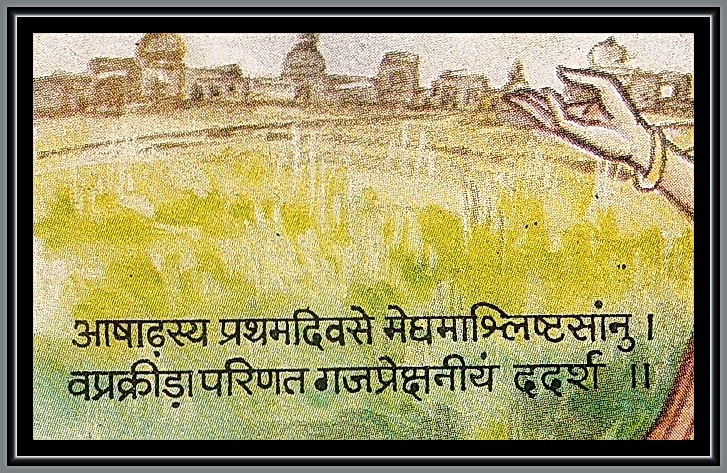
Bihar Postal Circle, Patna issued this historic special cover  - a numbered* and signed** limited edition - with pigeon cancellation on the occasion of BIPEX-86 (Bihar Philatelic Exhibition-86) on 26.12.1986. No information, as is general with India special covers, about the quantity printed or the designer's name, etc. is available. I salute the Conceptor and the Designer for having conceived the theme of Yakṣa from the Meghadūtaṃ, one of Kālidasa's most illustrious and charming works, with the verse printed on it in Sanskrit.***


तस्मिन्नद्रौ कतिचिदबलाविप्रयुक्तः स कामी
नीत्वा मासान् कनकवलयभ्रंशरिक्तप्रकोष्ठः 
आषाढस्य प्रथमदिवसे मेघमाश्लिष्टसानुं
वप्रक्रीडापरिणतगजप्रेक्षणीयं ददर्श
tasminn adrau katicid-abalā-viprayuktaḥ sa kāmī
nītvā māsān kanakavalaya-bhramśarikta-prakoṣtaḥ

āṣāḍhasya prathama-divase megham-āśliṣta-sānuṃ
vaprakrīḍā-pariṇata-gaja-prekṣanīyaṃ dadarśa

-- Meghadūtaṃ, 1.2.

[Separated from his wife, having passed several months on these hills pining with desire, his arm having become bare by the slipping off of the golden bracelet;] on the first day of Āṣāḍha he saw a mountain-top-embracing cloud, to all appearance, like a butting elephant preparing to thrust against a wall.
-- (Tr. Courtesy: Colonel H. A. Ouvry, The Meghadūta or Cloud Messenger by Kālidāsa, Williams & Norgate, Edingburgh,1868)

-----------
*I welcome information regarding the number printed from philatelic fraternity. 
**The cover is signed by the then Postmaster General, Sri M. S. Raghavan.
***Mis-spelt at two places on the cover : सांनु for सानुं and प्रेक्षनीयं for प्रेक्षणीयं.

Unwanted Notes 
1. Meghadūtaṃ is a famous sandeśa-kāvya of Kālidāsa. It has 111 ślokas or stanzas/verses.  
2. Sanskrit Commentaries on this poem: 
    Mallinātha (named, Sañjīvanī, Bombay, 1895)
    Dakṣināvartanātha (ed. T. Gaṇapati Śāstrin, 1919)
    Vallabhadeva (ed. Eugen Hultzsch,1911)
    Seṣarāj Śarmā Regmī (named, Saraḷā, 1964)
3. An orientalist, Horace Hayman Wilson, first translated Meghadūtaṃ into English and published it in  1813. Thereafter a number of editions and translations have come out.

Raghunath - 3rd Battalion The Jammu & Kashmir Rifles, 2005 - Army Cover


Heroism, valour and dedication to duty have been synonymous with the 3rd Battalion, Jammu and Kashmir Rifles ever since it came into being on 15th April 1856 at Raghunath Mandir, Jammu.


प्रशस्ता रणवीरता
praśastā raṇavīratā
"Valour in battle is praiseworthy"


In commemoration of the 150th anniversary of the Battalion, the Army Postal Service issued a special cover with the insignia, a special cancellation and a brochure on 17.04.2006.